Hospitality Industry Trends Shaping the Future in 2026 to 2027

The hospitality industry is being reshaped at speed by artificial intelligence, changing guest expectations, sustainability pressures and persistent workforce shortages. Hotels, resorts and travel businesses are no longer competing on service quality alone. They are expected to personalise every stage of the guest journey, operate responsibly and build careers that appeal to a new generation of professionals.
According to the World Travel & Tourism Council (WTTC), Travel & Tourism remains one of the world’s largest economic sectors, contributing more than 10% of global GDP. This article examines the future hospitality trends shaping hotels today, and what they mean for businesses, employees and hospitality education.
Hospitality Industry Outlook: What the Latest Data Shows
Global travel demand remains strong, but performance is far from uniform. Growth varies by region, hotel segment and property type, and rising labour, energy and food costs continue to squeeze margins even as bookings hold up. Understanding this data-led backdrop helps explain why the hospitality industry trends below are gaining momentum so quickly.
A few figures illustrate the current picture:
- Travel & Tourism is projected to contribute around US$11.7 trillion to the global economy, roughly 10.3% of global GDP (WTTC Economic Impact Research).
- The sector supports more than 370 million jobs worldwide, a number expected to keep climbing as demand grows (WTTC Economic Impact Research).
- Traveller interest in sustainability, personalisation and digital convenience continues to rise when choosing accommodation (Statista).
- Hotels are simultaneously facing higher labour, energy and food costs, making operational efficiency a priority rather than a preference.
These pressures are not separate issues. Artificial intelligence supports efficiency, sustainability initiatives lower long-term costs, and personalised experiences build loyalty. Together, they are reshaping the future of the hospitality industry.
For hotel owners and operators, this means the old playbook of chasing occupancy and average daily rate in isolation is no longer enough. Profitability now depends on how well a property connects its technology, its people and its environmental commitments into one coherent strategy. A strong brand is thus shaped by a guest’s impression of service, sustainability and digital convenience combined.
10 Future Hospitality Trends Shaping the Industry
The trends below overlap rather than operate in isolation. Few are single technologies or short-lived fashions; most combine changing traveller behaviour with new tools and new expectations of the hospitality workforce.
1. AI and Automation with a Human Touch
Hotels are using artificial intelligence for demand forecasting, dynamic pricing, marketing, scheduling and round-the-clock guest enquiries. Revenue management systems can weigh booking patterns, local events and competitor pricing in real time, while predictive scheduling helps managers staff busy periods more efficiently.
Recent industry analysis suggests AI adoption in hospitality is still at an early stage: research cited in a Swiss Education Group industry briefing points to fewer than 10% of hospitality businesses currently being considered “future-ready” on AI, leaving a wide competitive gap for early adopters to close.
The intent, though, is not to replace people. As Markus Venzin, CEO of the EHL Group, has explained, autonomous AI systems free employees to focus on what he calls “the human touch” in hospitality. Institutions within Swiss Education Group have responded by weaving digital tools, AI-related learning and virtual reality into their programmes, alongside the communication and leadership skills hospitality has always demanded.
This balance between automation and human judgement is becoming a defining feature of hospitality management. Hotels that lean too heavily on automation risk losing the warmth guests expect from a stay, while those that ignore AI altogether risk falling behind on pricing accuracy, staffing efficiency and personalised marketing. The most successful properties tend to treat AI as infrastructure, using it quietly to inform decisions while keeping human staff visible at every meaningful touchpoint.
2. Hyper-Personalised Guest Experiences
Connected guest profiles, loyalty data and AI now let hotels tailor almost every touchpoint: room type, dietary needs, amenities, communication preferences and restaurant or spa recommendations based on past behaviour.
The upside is measurable: guests who feel recognised return more often, refer to the property, and respond better to targeted upgrades.

The trade-off is responsibility. As personalisation deepens, hotels must be transparent about how data is collected and stored, and treat consent, cybersecurity and ethical AI use as core operational requirements rather than afterthoughts. Technology can surface a guest’s preferences, but it still takes attentive staff to turn that information into a truly memorable stay.
3. Smart Hotels, Mobile Journeys and Contactless Service
Mobile booking, digital keys, contactless check-in, mobile payments and app-controlled room settings are becoming standard rather than novel. Guests increasingly expect friction-free digital journeys from the moment they plan a trip.
Behind the scenes, cloud-based property management systems (platforms such as those from Oracle Hospitality are widely used across the sector) let departments coordinate more easily. Connected devices track energy use, occupancy and maintenance needs. This leads to faster service and more time for staff to focus on guests directly. Future managers will need to be comfortable working across cloud platforms, mobile ecosystems and building-management systems as part of everyday operations.
Voice-controlled assistants, intelligent lighting and app-based concierge services are also becoming more common in mid-range and luxury properties alike. This trend rewards hotels that integrate their systems rather than bolting on new apps one at a time, since a fragmented digital experience can frustrate guests almost as much as no digital experience at all. Staff training now increasingly includes basic troubleshooting for these systems, so employees can step in smoothly whenever technology falls short.
4. Sustainability Becomes an Operating Standard
Sustainability has moved from a marketing message to a measurable operating requirement. Hotel groups are investing in:
- Renewable energy and energy-efficient buildings
- Water-saving technologies
- Food waste reduction across kitchens and restaurants
- Elimination of single-use plastics
- Local sourcing of ingredients and products
- Transparent sustainability and ESG reporting
According to Statista, a growing share of global travellers now factor environmental practices into where they choose to stay. The conversation has also moved beyond simply reducing harm. Many operators now discuss regenerative hospitality, which aims to leave destinations better off by supporting biodiversity, local economies and community wellbeing. Hospitality programmes are increasingly integrating sustainability into finance, operations and entrepreneurship modules rather than teaching it as a stand-alone subject.
5. Wellness, Longevity and Preventative Hospitality
Wellness has expanded well beyond the spa. Guests increasingly view a hotel stay as a chance to improve sleep, nutrition, movement and mental wellbeing, not just relax for a weekend.
Properties are responding with sleep-focused room design, healthier dining, guided mindfulness, outdoor programming and biophilic architecture that strengthens the connection to nature. The underlying idea, known as preventative hospitality, is to design environments that actively support healthier living through better air quality, natural light and restorative sleep, rather than only offering relief after stress has already built up. For staff, this means increasingly working alongside nutritionists, wellness specialists and fitness experts as part of day-to-day guest service.
This shift is also visible in how hotels train their culinary and front-of-house teams. Menus are expanding to include more plant-based, allergen-aware and nutrient-dense options, while spa and fitness programming is being designed around measurable outcomes such as sleep quality or stress reduction rather than one-off indulgence. For business travellers in particular, wellness features such as circadian lighting, quiet workspaces and healthier in-room dining have become key differentiators when choosing where to stay, as opposed to added perks.
6. Experience-Led Travel, Bleisure and Flexible Stays
Many travellers are now asking what they will experience before exploring where they will stay. Hotels have responded by partnering with local chefs, artisans and tour operators to offer authentic, regionally rooted activities that help a property stand out.
This has coincided with new work patterns. Remote work has fuelled “workations,” and “bleisure” travel – extending a business trip for leisure – continues to grow. To meet this demand, hotels increasingly offer:
- Flexible workspaces and co-working lounges
- High-speed internet and business facilities
- Longer-stay accommodation packages
- Multi-purpose public areas
- Partnerships with local experience providers
- Activity-based itineraries
WTTC’s Global Trends research points to continued growth in both experience-led and business-leisure travel, reinforcing why destination knowledge and partnership-building are becoming core hospitality skills, alongside creativity and storytelling.
7. Workforce Shortages and New Talent Models
People remain hospitality’s greatest asset and one of its hardest challenges to solve. Recruitment and retention pressures have persisted since the pandemic, driven by rising labour costs and shifting employee expectations. WTTC projects that Travel & Tourism will support 91 million additional jobs globally by 2035, a figure that underlines both the sector’s growth and the scale of the talent gap it must fill.
In response, many hospitality organisations are cross-training staff across departments, investing in professional development and building clearer career pathways rather than relying solely on traditional recruitment. Automation is helping too, but as a complement to people: AI increasingly absorbs repetitive administrative work, leaving employees to focus on the empathy- and judgement-driven interactions technology cannot replicate.
Today’s graduates are also looking for more than a paycheque. They increasingly want:
- Flexible career pathways
- International opportunities
- Continuous learning
- Inclusive workplaces
- Healthy work-life balance
- Room to innovate and lead
Hospitality schools have a role to play in closing this gap. Institutions such as Swiss Education Group prepare students through internships, multicultural learning environments and practical operational experience, aiming to graduate professionals who are adaptable, internationally minded and able to move confidently across departments and technologies, rather than trained narrowly for a single role.
8. Profit Discipline and Data-Led Operations
Occupancy and average daily rate still matter, but hospitality leaders are increasingly judged on profitability rather than revenue alone. Rising labour, energy and operating costs have made disciplined, data-led decision-making essential.
Hotels are connecting revenue management systems, property management platforms, CRM tools and financial reporting to build a fuller picture of performance. Metrics under closer watch now include:
- RevPAR (Revenue per Available Room): room revenue efficiency
- GOPPAR (Gross Operating Profit per Available Room): overall profitability
- Labour productivity and scheduling efficiency
- Guest satisfaction and online reputation
- Marketing return on investment
- Ancillary revenue from dining, wellness and events
For future professionals, commercial awareness is becoming as important as operational skill. Graduates increasingly need to interpret financial and guest data confidently, not just manage service delivery.
This shift also changes how hotel departments work together day to day. Revenue managers, marketing teams and operations leaders increasingly meet around shared dashboards rather than separate reports, making pricing, staffing and promotional decisions collaboratively instead of in isolation. Graduates entering the industry are expected to read these dashboards comfortably from their first year on the job, treating data literacy as a baseline skill rather than a specialism reserved for finance teams.
9. AI Search, Social Discovery and Direct Booking
Search engines remain important, but travellers increasingly discover hotels through social media, creators, short-form video and conversational AI tools. This is changing how hospitality brands need to show up online.
Rather than optimising for search rankings alone, hotels now need trustworthy, engaging content across multiple channels. Strong photography, authentic storytelling, guest reviews and well-structured website information all improve visibility in both traditional and AI-assisted search. Video, in particular, is expected to play a growing role in how travellers explore destinations before booking.
Direct booking strategy still matters just as much. Loyalty programmes, personalised offers and smoother booking experiences continue to encourage guests to book directly, protecting both customer data and distribution costs. Generative AI is best understood as an additional discovery layer, one more way travellers compare options. However the real drivers of the booking decision continue to be trust, reputation and strong guest experiences.
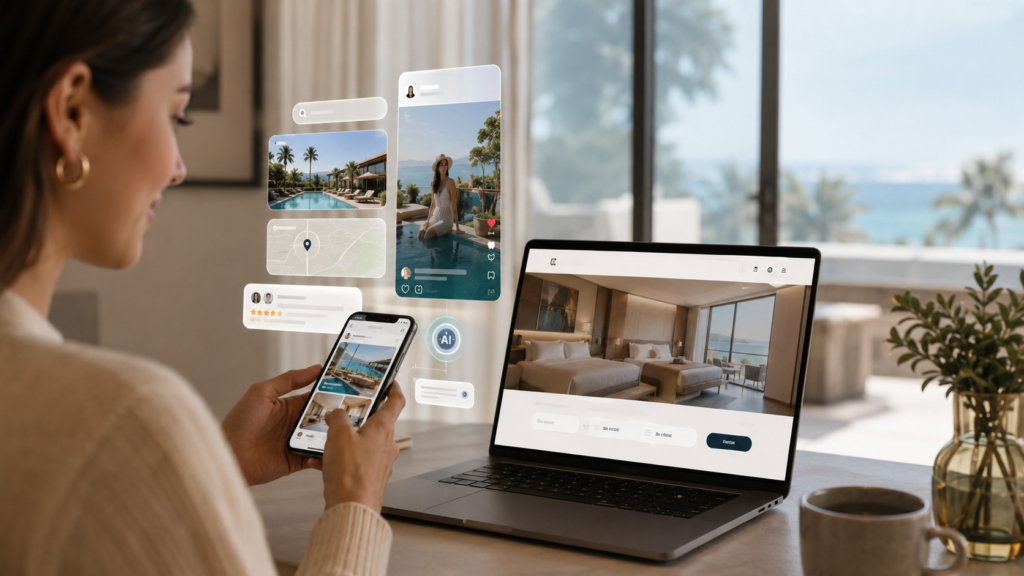
Hotel marketing teams are learning to write and structure content in ways that AI assistants can parse accurately, since a confused or outdated summary from a chatbot can misrepresent a property just as easily as a bad review. Consistent, up-to-date information across a hotel’s own website, its booking channels and third-party listings has become a practical necessity rather than a nice-to-have detail of digital marketing.
10. Multi-Use Spaces and the Hotel of 2030
Hotels are increasingly designing spaces to serve several purposes across a single day rather than fixing one use per room. A guest room might function as a workspace in the morning and a wellness retreat by evening; lobbies increasingly blend reception, café, co-working and community space.
Intelligent building-management systems will help this flexibility work in practice, adjusting lighting, temperature and room configuration to occupancy and guest preference. Sustainability is also expected to be designed in from the outset, with renewable energy, water conservation and circular design principles as standard features rather than later add-ons. According to McKinsey’s outlook for hospitality in the 2030s, technology is likely to operate increasingly in the background, freeing employees to focus on personalised, meaningful guest interaction.
For hospitality graduates, this trend points toward a broader shift in what hotel design and operations roles will look like by the end of the decade. Understanding space planning, sustainability standards and guest behaviour data will matter as much as traditional operational knowledge, and the most adaptable hotels are likely to be the ones willing to redesign how a space is used long after it was first built, rather than treating the original layout as fixed.
How Hospitality Trends Are Changing Jobs and Skills
As the industry evolves, so do the skills needed to succeed in it. Customer service, communication and leadership remain essential, but they increasingly need to sit alongside technological confidence and commercial awareness. The World Economic Forum’s Future of Jobs Report 2025 estimates that nearly 40% of workers’ core skills are expected to change by 2030, a reminder that continuous learning is no longer optional in hospitality or any other sector.
Future-ready skills for hospitality graduates increasingly include:
- AI and digital literacy
- Data interpretation and business analytics
- Revenue and commercial awareness
- Sustainability and ESG knowledge
- Emotional intelligence
- Intercultural communication
- Critical thinking and problem-solving
- Adaptability and resilience
- Leadership and collaboration
- Creativity and innovation
Many of these skills travel well beyond hotels. As service quality becomes a differentiator across industries, hospitality graduates increasingly build careers in luxury retail, aviation, events, consulting, customer experience and technology. As the sector continues to evolve, exploring the latest hospitality industry trends helps put into perspective just how wide these career opportunities have become.
Employers across these sectors increasingly look for the same combination of qualities: a graduate who is comfortable interpreting data, managing a diverse team and staying calm when a plan changes at short notice. Hospitality’s traditional emphasis on service under pressure gives graduates a genuine advantage here, since few other degree paths offer the same volume of hands-on, high-stakes people management experience before a student even finishes their studies.
How Hospitality Education Must Respond
Preparing students for hospitality’s future takes more than teaching hotel operations. Future professionals need grounding in digital transformation, sustainability, business performance, entrepreneurship and leadership, and they need to apply these ideas in real business settings rather than only in the classroom.
Leading hospitality schools are building this into their programmes through live industry projects, international internships, hands-on use of hotel technologies and exposure to sustainable business models. This blend of academic study and applied practice is what helps graduates develop the adaptability the industry now demands.
In a world increasingly shaped by automation, AI and rapid technological change, hospitality education must continue to reflect current hospitality industry trends, from digital transformation and sustainability to evolving workforce needs. Many Swiss institutions have also expanded into postgraduate diplomas that respond directly to the latest trends in the hospitality industry, including digital marketing, sustainable operations and advanced leadership skills for an increasingly complex sector.
Swiss Education Group is one example of how hospitality schools are connecting classroom learning with real-world industry practice, combining multicultural learning environments with practical training that mirrors real hotel operations. As Markus Venzin of the EHL Group has put it, technology should enhance hospitality rather than replace its human foundations, which means graduates need both digital confidence and the interpersonal skills that have always defined good service.
For families weighing hospitality education options, how a school responds to industry change matters as much as rankings or campus facilities. Practical experience, international exposure, commercial understanding and transferable skills are increasingly what employers look for first. Readers exploring their options may find it useful to look at the reasons to choose SEG, which sets out how Swiss hospitality education pairs academic learning with real industry experience.
Prospective students often ask how to tell whether a hospitality programme is genuinely preparing them for this changing landscape, rather than teaching traditional operations alone. A useful test is to look at how a curriculum treats technology, sustainability and data: whether these appear as standalone modules bolted onto an otherwise unchanged programme, or are woven through finance, marketing, operations and leadership courses as a matter of course.
What Will the Hospitality Industry Look Like by 2030 and Beyond?
No one can predict hospitality’s future with total certainty, but current evidence points to an industry that is likely to become more personalised, digitally connected and environmentally responsible, while staying firmly centred on people’s experiences.
Artificial intelligence is likely to keep automating routine processes, giving employees more time for relationship-building and complex problem-solving. Hotels may increasingly become flexible spaces that support work, wellbeing, social connection and longer stays, with sustainability embedded throughout design and operations rather than bolted on afterwards. WTTC’s long-term projections suggest travel demand and employment could continue growing over the next decade, creating real opportunities for professionals able to adapt to technological and social change.
Technology will undoubtedly reshape hospitality, but it is unlikely to replace what defines great service: empathy, cultural awareness, communication, leadership and creativity. Hospitality remains one of the most resilient, adaptable and dynamic industries, with technology, changing guest expectations and new service models continuing to reshape the sector. Read more about the future trends in the hospitality industry and the skills graduates will need to succeed.
For students and parents considering this path, the takeaway is straightforward: hospitality remains a people-first industry, but tomorrow’s professionals will need to understand technology, sustainability and business performance just as fluently as they understand service.
Frequently Asked Questions
What are the biggest hospitality industry trends in 2026?
Key trends include artificial intelligence, hyper-personalisation, smart hotels, sustainability, wellness tourism, experience-led travel, workforce transformation, data-led operations and flexible hotel spaces.
What is the future of the hospitality industry?
It is likely to combine advanced technology with personalised service, sustainable operations and adaptable business models, with human interaction remaining a key competitive advantage even as automation increases.
How is AI changing the hospitality industry?
AI supports revenue management, demand forecasting, marketing, customer service, scheduling and operational efficiency, freeing employees to spend more time on customised guest experiences.
Will hospitality jobs be replaced by automation?
Many routine administrative tasks are likely to be automated, but roles built on empathy, leadership, creativity and complex decision-making are expected to remain essential.
Why is sustainability important in hospitality?
Sustainability reduces environmental impact, improves operational efficiency and meets rising traveller expectations for responsible tourism, making it a core business strategy rather than a marketing add-on.
What skills will future hospitality professionals need?
A combination of digital literacy, AI awareness, commercial understanding and sustainability knowledge, alongside communication, leadership, emotional intelligence and adaptability.
How should hospitality education prepare students for future trends?
By combining academic learning with internships, live industry projects, exposure to hotel technologies, sustainability, entrepreneurship and international collaboration.
How has technology changed the hospitality industry?
It has transformed booking, guest communication, revenue management, hotel operations and customer service, while enabling greater personalisation, efficiency and data-driven decision-making.