It Takes a Village: Supporting young people’s mental health together
Why giving parents, teachers and other trusted adults practical mental health first aid skills can make it easier for a young person to speak and to find the right support.

Written by Dr Mecky Mcneil
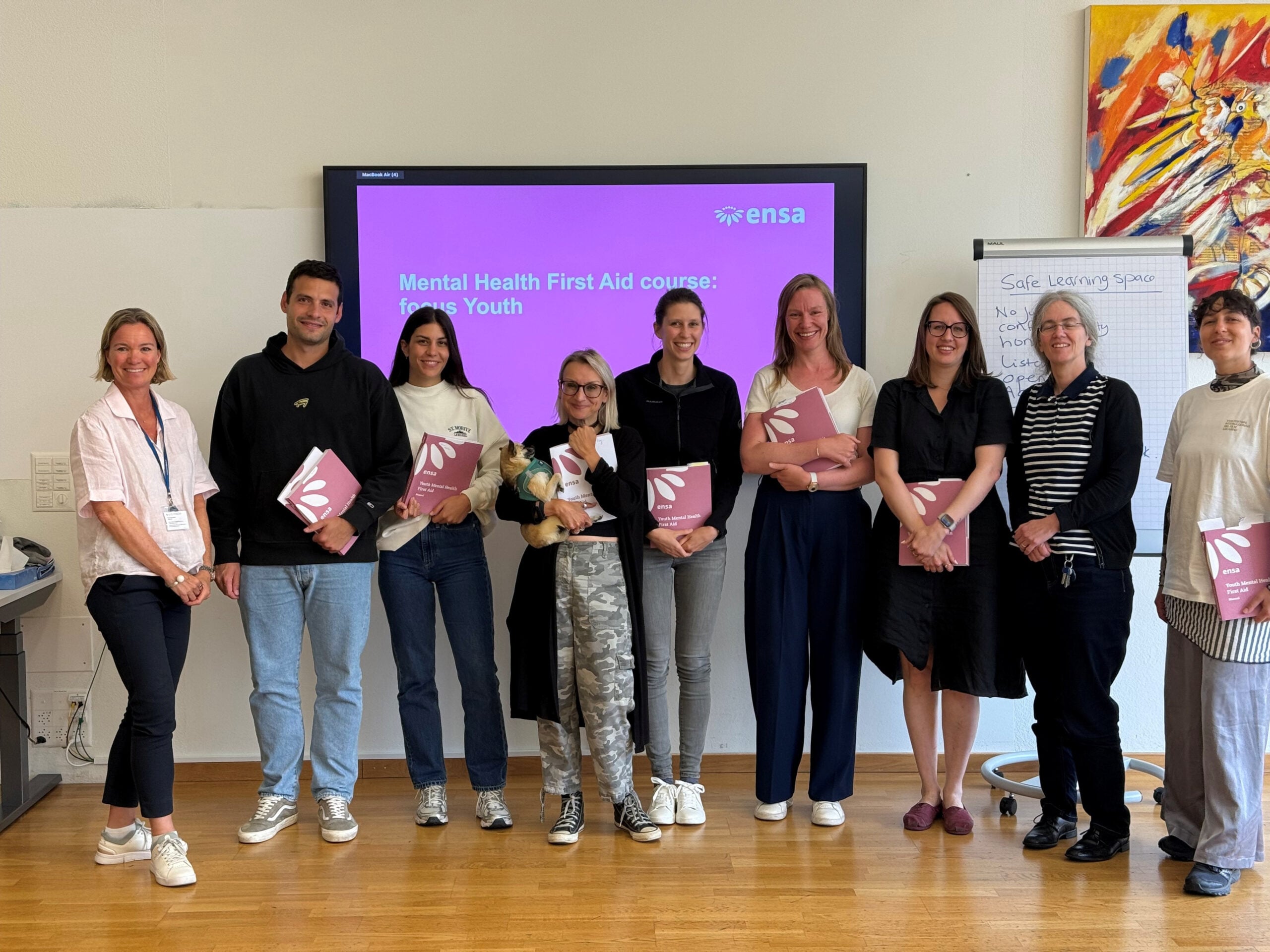
On a cool early-summer evening, I arrived in the beautiful Engadin village of Zuoz. Church bells and distant cowbells carried across mountain meadows, with the surrounding peaks rising beyond them. The next morning, I walked uphill to Lyceum Alpinum Zuoz to begin a three-day training course. In the corridors, I heard students speaking German, English and Italian. An international group of teachers and school staff had gathered in the training room, ready to learn how to support a young person who may be struggling with their mental health.

They brought warmth, experience and difficult real-life questions. What do you say when a student withdraws from friends, stops handing in work or seems constantly on edge? When should normal adolescent change cause concern? What if a young person mentions suicide? And how can an adult help without taking over? Those questions helped create a collaborative learning environment grounded in a shared commitment to notice, listen and act.
WHY THE ADULTS AROUND YOUNG PEOPLE MATTER
Mental health problems in adolescence are common. The World Health Organization estimates that one in seven 10–19-year olds worldwide experiences a mental health condition.1 Taking a closer look at Swiss data, an Obsan survey conducted in autumn 2022 found that 35.9% of young women and 15.3% of young men aged 15–24 reported severe psychological symptoms.2
Many mental illnesses begin early. A large international meta-analysis found that over a third of mental illnesses begin before the age of 14, about half before 18 and nearly two-thirds before 25, with the peak age of onset occurring at around 14–15 years.3 This matters because difficulties during these formative years can affect learning, relationships, physical health and later opportunities. It also creates a window for early support. A teacher, coach, boarding parent or family member may notice a change long before a young person reaches a professional service.
“It takes a village to raise a child” captures our shared responsibility. A young person may not turn to a parent. A teacher may notice a decline in schoolwork, a coach may see a loss of confidence, or boarding staff may observe withdrawal from friends; each may see something different. Together, we can recognise concerns earlier and connect a young person with support. First Aiders neither diagnose nor provide therapy. As in physical first aid, they recognise something may be wrong, offer calm initial support and help the young person reach appropriate help.
WHAT THE COURSE GIVES A SCHOOL COMMUNITY
The 14-hour ensa Mental Health First Aid course “Focus Youth” is designed for adults who care for or work with young people, including parents, teachers, school counsellors, boarding staff and youth leaders.4 It covers common mental health problems and crises, including anxiety, depression, eating disorders, substance use, psychosis, suicidal thoughts, non-suicidal self-injury, panic attacks and traumatic events.
The heart of the training is practising real conversations. Through films, discussion and small-group exercises, participants practise how to approach a young person, listen openly and without judgement, assess urgency, encourage appropriate help and continue to support them. We explore confidentiality, safeguarding, culture and the limits of the First Aider’s role. Research reviews consistently find that Mental Health First Aid (MHFA) training improves participants’ knowledge, attitudes and confidence to help.5
At Zuoz, the practice conversations were where knowledge became usable. Many participants already had excellent instincts. A framework helped validate those strengths, while offering language for moments when fear can make even a caring adult hesitate. Over 14 hours, the group challenged assumptions, learned from one another and rehearsed conversations that could be lifesaving.
“At the end of the course, we left feeling grateful for the experience, inspired by one another and hopeful about the difference we could make.”
A SWISS PROGRAMME WITH INTERNATIONAL ROOTS
ensa is the Swiss version of the MHFA International programme, which originated in Australia. The Swiss foundation Pro Mente Sana holds the MHFA licence for Switzerland. With support from the Beisheim Foundation, Pro Mente Sana established ensa and continues to strengthen its reach. HealthFirst is a Pro Mente Sana partner licensed to deliver the courses in English and has trained teachers and staff from over 15 international schools across Switzerland in the Focus Youth course.6
The Focus Youth training at Lyceum Alpinum Zuoz was delivered with financial support from the Health Promotion Unit of the Graubünden Health Department, helping to make this practical mental health training available to members of the school community.
CONFIDENCE TO BEGIN
At the end of the course, we left feeling grateful for the experience, inspired by one another and hopeful about the difference we could make. I had watched a group of colleagues become more confident in asking direct, compassionate questions, and in knowing when to involve others. They had not become therapists. They had become better prepared adults in a young person’s village.
Schools cannot remove every pressure a young person faces. But they can create communities in which changes are noticed, difficult feelings can be named and reaching out is met with care rather than judgement. Sometimes the most important intervention begins with an ordinary sentence: “I’ve noticed you don’t seem yourself lately, how are things for you?” The course helps adults feel ready to ask, and ready to stay for the answer.
References
1. World Health Organization. Mental health of adolescents (updated 1 September 2025). https://www.who.int/news-room/fact-sheets/detail/adolescent-mental-health
2. Peter, C., Tuch, A. & Schuler, D. (2023). Psychische Gesundheit – Erhebung Herbst 2022: Wie geht es der Bevölkerung in der Schweiz? Sucht sie sich bei psychischen Problemen Hilfe? Obsan Bericht 03/2023. Neuchâtel: Schweizerisches Gesundheitsobservatorium. Report and download page. https://www.obsan.admin.ch/de/publikationen/2023-psychische-gesundheit-erhebung-herbst-2022
3. Solmi M et al. Age at onset of mental disorders worldwide: large-scale meta-analysis of 192 epidemiological studies. Molecular Psychiatry. 2022;27:281–295. https://doi.org/10.1038/s41380-021-01161-7
4. ensa. Mental Health First Aid: Focus Youth—course overview. https://www.ensa.swiss/en/youth/course/
5. Mental Health First Aid International. MHFA Program Evaluations. https://mhfainternational.org/mhfa-program evaluations/
6. HealthFirst internal programme records, August 2026.