Le Rosey vs Beau Soleil: Which Swiss Boarding School Is Right for Your Child?
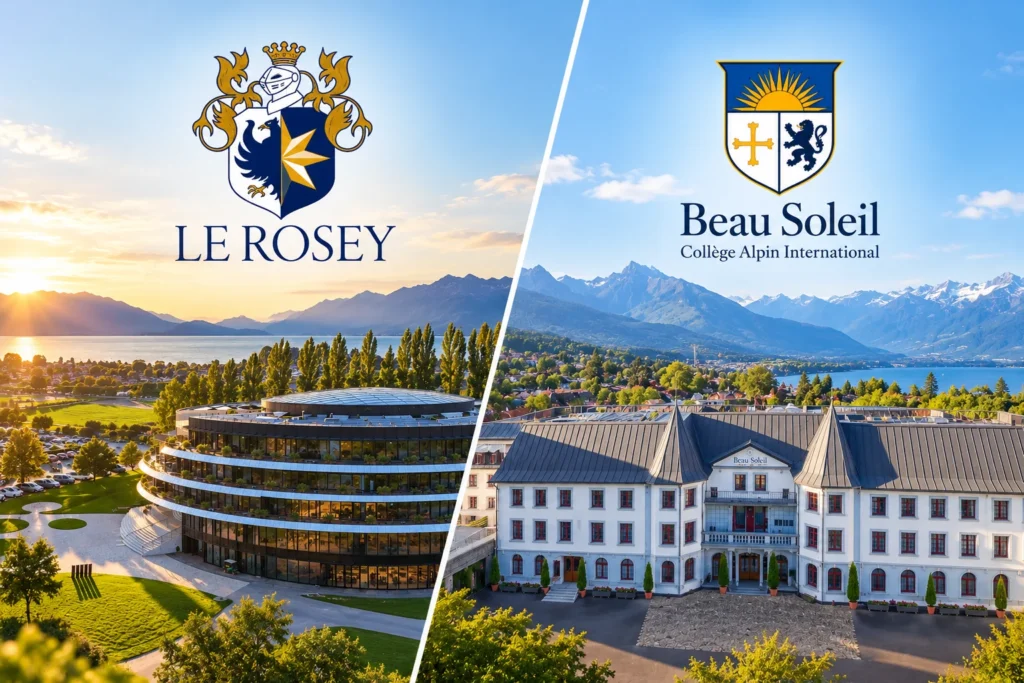
If you’re comparing Le Rosey and Collège Alpin International Beau Soleil, you probably already know that they are both prestigious, co-educational Swiss boarding schools with a diverse international student body. Yet some of their differences include location, campus model, entry age, curriculum, language exposure, boarding culture and total cost. Le Rosey welcomes students aged 8 to 18 and moves between Rolle and Gstaad during the year. Beau Soleil educates students aged 11 to 18 at one alpine campus in Villars-sur-Ollon.
This comparison guide explains the main differences so you can confidently progress in your search for the best Swiss boarding school for your child.
Contents
- Le Rosey vs Beau Soleil at a glance
- Key differences between Le Rosey and Beau Soleil
- Which school may be better for your child?
- What should parents compare before deciding?
- Frequently asked questions
Le Rosey vs Beau Soleil at a Glance
The table below summarises the main differences between Le Rosey and Beau Soleil.
| Factor | Institut Le Rosey | Beau Soleil |
| Location | Rolle, canton of Vaud, and Gstaad, canton of Bern | Villars-sur-Ollon, canton of Vaud |
| Ages | 8 to 18 | Around 11 to 18 |
| School type | Co-educational school; 100% boarding | Co-educational school; almost all students board full time |
| Curriculum | International curriculum leading to the IB Diploma or French Baccalaureate | IB Middle Years Programme, followed by the IB Diploma and/or US High School Diploma |
| Main languages | English and French | English and French options within the IB Diploma, including a bilingual option |
| Campus model | Rolle for most of the year and Gstaad from January to March | One alpine campus |
| Annual boarding/tuition | CHF 159,600* for Cadets and Seniors in 2026–2027, with a separate lower Junior rate and additional charges | CHF 137,040* for Grades 6 to 10 or CHF 148,440* for Grades 11 to 12, plus compulsory annual charges |
| Best suited to | Younger boarding entry; strong bilingual model; choice of IB or French Baccalaureate | MYP to DP continuity; a US High School Diploma option; smaller alpine community |
*Bear in mind that the headline Le Rosey tuition and Beau Soleil tuition figures don’t represent every expense. Families should compare the compulsory charges for the relevant year group and request an individual quotation.
Key Differences Between Le Rosey and Beau Soleil
Le Rosey and Beau Soleil differ most notably in their settings, campus structures, academic pathways, language exposure and approaches to boarding life.
Location and campus experience
Le Rosey divides its academic year between two settings. Students spend most of the year at the Rolle campus beside Lake Geneva, then the school community moves to Gstaad from January to March. Morning lessons continue during the winter term, while most afternoons focus on snow and ice sports.
Beau Soleil remains at its Villars-sur-Ollon campus throughout the year. The school sits in an alpine village with ski slopes and winter activities nearby. This gives students a consistent home base while retaining regular access to mountain life.
Some children may enjoy the variety of moving between the lake and the mountains, while others may prefer the familiarity of one campus.
Age range
Le Rosey’s Junior section welcomes children aged 8 to 12, making it an option for families considering boarding during the primary years through to the final years of high school. Beau Soleil starts at age 11 and continues through to Grade 12. It may appeal to families who prefer their child to begin boarding around the transition to secondary school. When deciding which age to begin boarding school, it’s important to assess your child’s level of independence, emotional readiness and comfort with the idea of living away from home.
Curriculum
The schools have distinct academic pathways. At Le Rosey, younger students enjoy a tailored bilingual programme that leads into a pre-bac programme which prepares them for either the IB Diploma or the French Baccalaureate in their senior years. The Le Rosey IB can be completed in English, French or both languages.
At Beau Soleil, students aged 11 to 16 follow the IB Middle Years Programme. In Grades 11 and 12, they can pursue the IB Diploma in English, French or both, or the more career-focused US High School Diploma.
English and French
Le Rosey has a personalised bilingual structure, acknowledging that the mother-tongue of more than half their students is neither English nor French. Students select English or French as their main language and study most subjects in it. As their proficiency develops, they can study at least one subject in the other language. Eligible students may also earn Le Rosey’s bilingual diploma before entering the final Baccalaureate years.
Beau Soleil offers the MYP in English and allows students to pursue English, French and bilingual options within the IB Diploma. Parents should ask which subjects are available in each language and compare entry expectations and language support.
Boarding life and school culture
The boarding experience at Le Rosey is highly structured, with formal dinners, evening study, age-based bedtimes and compulsory elements of the sports and arts programme. Students need permission to leave campus and must check in when they return. The Gstaad winter term is a central part of boarding life, complemented by a broad choice of arts, sports, technology, service and cultural activities.
Beau Soleil has around 300 students, almost all of whom live on campus. Its six boarding houses have twin or triple rooms, with boarding teams supporting students throughout the day and night. Daily tutor time and dedicated mentoring are also part of school life. Outdoor education plays a prominent role through winter sports, international trips and seven whole-school challenges involving activities such as hiking, running and teamwork.
Tuition and total cost
Published 2026–2027 Le Rosey fees for Cadets and Seniors were CHF 159,600 for boarding and tuition. Junior boarding carried a separate lower rate. The standard fee covered accommodation, meals, books, ski passes, standard sports teaching, compulsory expeditions, on-campus weekend activities and transport of belongings between Rolle and Gstaad.
Additional Le Rosey costs could include a CHF 3,000 registration fee, an expenses deposit, uniform, medical insurance, examination charges, optional trips, transport, private tuition and pocket money. The total varies by age and programme.
Beau Soleil’s published 2026–2027 fees were CHF 137,040 for Grades 6 to 10 and CHF 148,440 for Grades 11 to 12. The school also listed CHF 26,460 in other annual fees and an annual trip fee of CHF 8,490 for most grades.
New-student charges included a CHF 3,000 application fee, CHF 6,990 uniform package and CHF 15,000 deposit. Depending on the grade, recurring published charges could reach approximately CHF 171,990 to CHF 183,390 before individual extras.
Which School May Be Better for Your Child?
Neither school is the automatic best choice for every student. Le Rosey may be the stronger fit if your family places particular importance on:
- boarding from age 8;
- an established English and French bilingual model;
- a choice between the IB Diploma and French Baccalaureate;
- a school year divided between Rolle and winter in Gstaad;
- extensive arts, sports and cultural opportunities.
Beau Soleil may be particularly well suited to students who value:
- continuity from the IB MYP to the Diploma Programme;
- a US High School Diploma alternative;
- one alpine campus throughout the year;
- outdoor education, school challenges and international trips.
When comparing Beau Soleil and Le Rosey, consider the student’s academic plans, personality, language profile and preferred boarding environment.
What Should Parents Compare Before Deciding?
Before choosing between Le Rosey and Collège Alpin International Beau Soleil, the following aspects of each school should be carefully reviewed:
- age and preferred year of entry;
- IB, French Baccalaureate or US High School Diploma pathway;
- current English and French proficiency;
- a dual-campus year or one alpine base;
- boarding routines and level of independence;
- class size, language help and academic support;
- arts, sports and outdoor interests;
- university destination and entry requirements;
- annual fees, first-year charges and refundable deposits;
- assessments, interviews and other admissions requirements.
Families comparing Institut Le Rosey and Beau Soleil can also explore ISP’s guide to the best boarding schools in Switzerland to discover other leading schools and create a broader shortlist.
Frequently Asked Questions
Is Le Rosey better than Beau Soleil?
Neither is better in a general sense. Le Rosey suits families wanting a dual-campus year, boarding from a younger age and a bilingual academic structure. Beau Soleil suits families wanting a smaller community built around expeditions and personalised mentoring. The right choice depends on your child.
Which is more expensive, Le Rosey or Beau Soleil?
The answer depends on grade and compulsory extras. For 2026-2027 Le Rosey’s Cadet and Senior fee was CHF 159,600. Beau Soleil’s recurring published charges reached approximately CHF 171,990 to CHF 183,390 for most grades.
Does Le Rosey offer the IB?
Yes. The Le Rosey IB Diploma can be studied in English, French or through a bilingual combination.
Does Beau Soleil offer the IB?
Beau Soleil offers the IB, including the Middle Years Programme leading into the Diploma Programme.
Which school offers the French Baccalaureate?
Le Rosey teaches the French Baccalaureate as well as the IB Diploma. Beau Soleil’s current senior pathways are the IB Diploma and US High School Diploma.
Which school is better for bilingual English-French education?
Both schools run bilingual French-English programmes. However, Le Rosey has the more extensive school-wide bilingual structure. Beau Soleil has English, French and bilingual IB Diploma pathways.
Which school has the stronger boarding experience?
Both have extensive boarding programmes. Le Rosey follows a highly structured model across two seasonal campuses, while Beau Soleil has a slightly smaller community on one alpine campus.
What age can students join Le Rosey and Beau Soleil?
Le Rosey accepts students from age 8. Beau Soleil generally starts from around age 11. Always confirm current admissions ages directly with each school, as intake policies can change.
Does Beau Soleil offer a US High School Diploma?
Beau Soleil offers a pathway towards a US High School Diploma alongside its IB and French Bac options.
What is the main difference between Le Rosey and Beau Soleil?
The clearest difference is the campus model. Le Rosey moves between two campuses each year, Rolle and Gstaad, while Beau Soleil stays on a single alpine campus in Villars-sur-Ollon. From there, the schools diverge further on age range, curriculum structure and boarding culture, so it’s worth comparing all of these before making a decision.