What Office Spaces Are Really Saying

Written by: Ivana Nady, Zen Interiors
Where your outer space meets your inner evolution.
A few years ago, I landed a dream job. On paper, it was everything I wanted: purpose-driven, challenging, aligned with my values. I was ready to give it 120%.
And on my first day I saw where they placed me. The ice-cold realization washed over me.
There weren’t enough desks, so I was squeezed into a corner, haring overcrowded space with another colleague, facing a wall. My back was turned to a high-traffic passage, fully exposed. No privacy. No ownership of space. No energetic safety.
I wasn’t entry-level. I wasn’t new to the field. But in that moment, I received a clear message:
You are not valuable here.

My reptilian nervous system responded before my mind could:
Tension. Discomfort. Vigilance.
I started operating at maybe 60% of my capacity.
Not because I lacked skill or passion, but because I was environmentally unsupported.
And the organization?
They never knew what they missed out on.
They lost access to everything I could have brought, because they never considered what my space was saying and what it did to my nervous system.
This wasn’t personal. It was systemic.
In the months and years that followed, I started listening to other stories, colleagues, friends, professionals from across industries.
Different job titles. Same experience.
Cramped desks. No natural light. No privacy. No dignity.
All while organizations spent a fortune of change managers who boasted about values like inclusion, well-being, people-first culture.
And I realized:
We’ve created a dangerous gap between what organizations say and what their spaces actually reflect.
I call this the Spatial Integrity Gap:
The measurable distance between a company’s spoken values and the lived experience of its physical environment.
If your space contradicts your culture, you don’t have a culture. You have branding.
We’ve all seen it:
Leadership teams tucked into inaccessible private offices.
Junior staff exposed in chaotic open plans.
“Wellness” slogans on slides, while fluorescent lights flicker overhead and burnout brews silently below.
Space doesn’t lie.

If transparency is a value, why are all the doors of management closed?
If collaboration is core, why the scarcity or communal spaces and meeting rooms?
If you care about mental health, why does the space induce stress?
This isn’t about aesthetics, it’s about alignment, it’s about integrity.
And the organizations that understand this? They are already winning.
Google. LinkedIn. Airbnb. Shopify.
These aren’t just companies with nice offices. They’re companies that understand the psychological power of space.
They design for:
- Focus zones and creative flow
- Biophilic elements for mental clarity and stress relief
- Choice-driven layouts that empower different work styles
- Environments that reflect their values, not just their branding
And research backs it:
- Natural light boosts productivity by 18%
- Workplace satisfaction improves by 30% when people feel autonomy over their space
- Thoughtful design increases retention, creativity, and trust
It’s not luxury, it’s leverage.
The shift that’s needed now
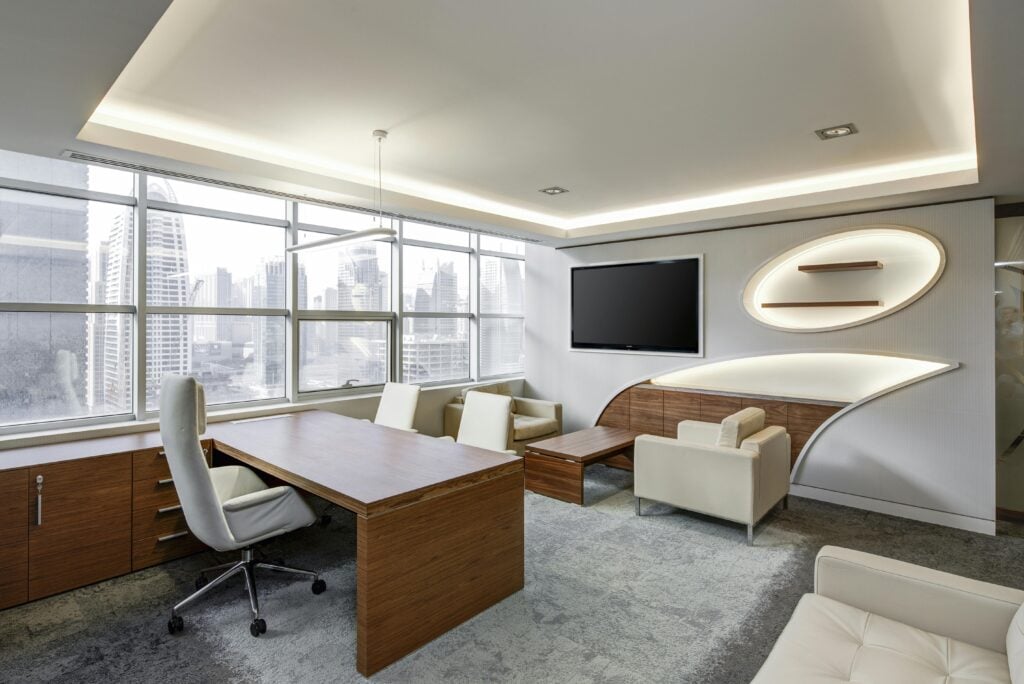
Most organizations are still operating in environments built for another era. Spaces that reflect hierarchy, surveillance, scarcity, not creativity, trust, or innovation. And that mismatch is expensive, because people can feel it. Your most intuitive, brilliant, self-aware employees will quietly disengage. They won’t always complain, they’ll just never give you their full potential.
This is your call forward.
If you’re in a leadership role, ask yourself:
What is my space silently saying to my team?
Who is included, and who is just tolerated?
Where am I reinforcing the past instead of designing for the future?
You don’t need a renovation budget, so don’t hide behind tight budgets. You need awareness and willingness to welcome change. You need someone who can read the room, literally.
Because space is a language, and it’s speaking to your people long before you say a word.