Hospitality Summer Programmes for High School Students

The first morning at a hospitality summer camp brings an unexplored campus, new faces and an opportunity to gain first-hand insight into a possible future. Through direct participation, high school students are introduced into the world of hospitality, allowing them to move beyond what they have read in a prospectus.
A hospitality summer programme combines academic workshops with practical activities, industry exposure, campus life and social experiences. Far from focusing solely on hotel operations, a hospitality summer school aims to introduce participants to the wider hospitality landscape including business, luxury, events, tourism and culinary arts.
Essentially, they offer students who are interested in hospitality, but uncertain about their future direction, the opportunity to discover which subjects inspire them and whether the industry reflects their ambitions.
Hospitality Summer Programmes to Consider
Switzerland has, for generations, occupied a particular place in the history of hospitality education, and Swiss Education Group (SEG) is among the names families encounter as they research options. SEG brings together several schools dedicated to hospitality, business and culinary arts, and its summer offering allows younger students to step into that world before applying to a full degree programme.
Two programmes, in particular, offer an introduction to the field: the Swiss Business & Hospitality Camp and the Swiss Culinary Camp, both delivered through Swiss Education Academy, which sits within the wider SEG family of schools. Each takes a different route into the hospitality industry: one through business and leadership, the other through the discipline and creativity of the kitchen. Both provide practical insight into different areas of hospitality.
Swiss Business & Hospitality Camp — Swiss Education Academy (SEG)
The Swiss Business & Hospitality Camp welcomes students aged 16 to 20, with weekly sessions that run from late June to mid-August. The programme combines practical classes in hospitality, leadership and entrepreneurship with industry exposure, excursions and opportunities to meet students from different countries.
The setting is Montreux, on the shores of Lake Geneva, where the rhythm of the camp mirrors the elegance of its surroundings. Students move between hands-on workshops covering hospitality fundamentals, discussions of how business thinking underpins guest experience, and opportunities to exchange ideas and build friendships with peers from other countries. Each day balances structured learning with excursions and time for reflection. As a result, the week feels neither entirely academic nor purely recreational.
The academic content gives students several ways to test their interest in the industry. The published 2026 course plan includes Entrepreneurship and Leadership, Luxury Marketing, Swiss Hospitality Revealed and Communication Skills, although the subjects available vary by week. These classes introduce participants to the creation of a business concept, the behaviour of luxury consumers, the principles of hospitality and the communication skills expected in an international workplace. This makes the programme relevant to students considering business degrees as well as those already drawn to hotels, events or luxury.
Because Swiss Education Academy belongs to Swiss Education Group, the camp also introduces participants to SEG’s wider hospitality and business education environment before they begin researching degree options.
Swiss Culinary Camp — Culinary Arts Academy Switzerland Environment
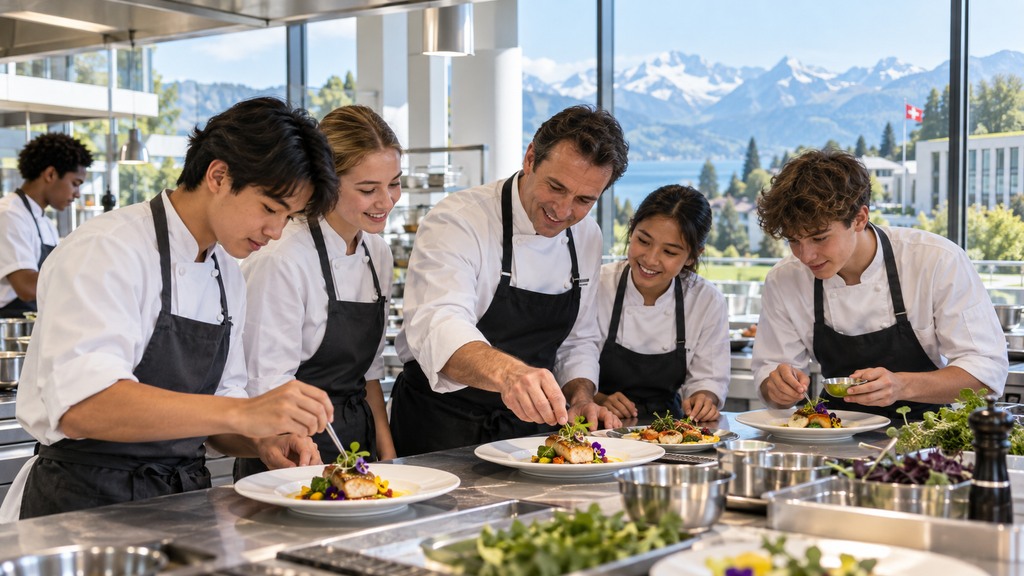
For a student whose interest lies closer to the kitchen, the Swiss Culinary Camp offers an equally immersive alternative. Open to students aged sixteen to twenty, it introduces participants to the discipline and craft of a professional kitchen.
The programme is based at the Le Bouveret campus of Culinary Arts Academy Switzerland. Le Bouveret is a lakeside campus housed in a former hotel dating from the early twentieth century. Its specialist facilities include demonstration and training kitchens, alongside the Mosimann Collection, an exhibition devoted to the work and culinary heritage of chef Anton Mosimann. Participants stay in SEG accommodation, eat meals prepared by Le Bouveret chefs, and complete practical sessions within the academy’s teaching environment.
The published 2026 programme is organised around European Cuisine, Chocolate and Pastry, and World Cuisine. Students explore classic European techniques and regional dishes, practise pastry skills and chocolate tempering, and work with ingredients and cooking styles from different cultures. The weekly pattern places cooking classes on four weekdays with an excursion in the middle of the week. This rhythm introduces the preparation, timing and consistency required in a teaching kitchen while leaving space to experience the region.
The summer camp provides a hands-on introduction to culinary education and students find that a week or more on a culinary campus can give valuable insight into the standards and routines of a professional teaching kitchen.
SEG Schools Students Can Explore After a Summer Programme
A short summer camp often serves best as a beginning rather than a conclusion. Once a student has experienced hospitality or culinary education first-hand, it becomes easier to imagine which type of school might support their longer-term ambitions.
Within Swiss Education Group schools, students typically go on to consider a handful of distinct academic directions, among them:
- Swiss Hotel Management School (SHMS) – concerned with international hospitality management, hotel operations, leadership and luxury-focused study options.
- César Ritz Colleges Switzerland – built around hospitality business, entrepreneurship and leadership, with a pronounced business-management orientation.
- HIM Business School – business education rooted in hospitality, with pathways connected to luxury, finance, marketing and entrepreneurship.
- Culinary Arts Academy Switzerland – devoted to culinary arts, pastry, food entrepreneurship and culinary business management.
These four schools are all possible destinations for a student whose interest in hospitality has begun to take shape. The summer experience can help students identify whether they prefer hospitality operations, business management or culinary education.
The distinctions become clearer when students look at the programmes available after secondary school. Swiss Hotel Management School teaches hospitality management through a three-year bachelor’s degree that includes two internships and specialisations in hospitality management, event management or design. César Ritz Colleges Switzerland takes a business-led approach to hospitality and entrepreneurship, while HIM Business School connects hospitality with specialisations such as luxury brand management, financial analysis and wealth management, and franchise business management.
Culinary Arts Academy Switzerland follows a different path. Its academic portfolio includes one-year professional diplomas in culinary arts and pastry arts, three-year bachelor’s degrees in culinary arts and in pastry, bakery and chocolate arts, and a one-year master’s degree in culinary business management. The diploma and degree routes include internships, so students progress from technical teaching into professional settings.
A summer programme participant can more easily connect with a particular option, and understand whether the next step would involve hotel leadership, a broader business education or sustained training in a professional kitchen.
What Can High School Students Study at Hospitality Summer Programmes?
Hospitality, as a field of study, can be broader than what one might initially understand it to be. A summer course may introduce participants to business, luxury, events, tourism and culinary arts, often bringing several of these subjects together within the same week.
The precise balance varies from one camp to another. A business-led week may ask students to consider why guests choose one brand over another, how a team communicates a service promise or what makes a new hospitality concept commercially credible. A culinary programme places greater emphasis on ingredients, technique, food preparation and presentation. In both cases, the strongest activities connect an idea to an observable result, whether that result is a group presentation, a service concept or a finished dish.
Common areas of study include:
- Hotel and hospitality management – the essentials of guest services, front-of-house operations and hotel departments, from arrival through to housekeeping and beyond.
- Business and entrepreneurship – how commercial thinking, strategy and leadership apply within a service industry, including budgeting, marketing and the management of people.
- Luxury and guest experience – the qualities that distinguish premium hospitality, from personalised service to the smallest details of brand standards.
- Events and experience management – the planning and delivery behind conferences, weddings and large-scale gatherings, including logistics and client communication.
- Tourism and destination management – how regions and cities cultivate their appeal to visitors, and how this connects to the wider local economy.
- Culinary concepts – the fundamentals of the kitchen and an introduction to professional culinary standards, frequently guided by chefs with real industry exposure.
Because the industry spans so many specialisms, hospitality education tends to open doors beyond hotel management, a point worth bearing in mind when weighing up hospitality career paths. Many graduates move into luxury retail, events, finance or entrepreneurship. A summer programme offers a practical means of sampling several of these directions before deciding where to specialise, rather than relying on a single work placement or a family connection to one corner of the field.
These subjects rarely stand entirely apart. Events management involves budgeting and client communication, while culinary sessions may introduce food costs and kitchen management alongside practical cookery. So hospitality schools aim for students to understand that guest experience, business decision-making and operational detail are woven together, rather than existing as separate subjects to be studied in isolation. A programme that draws these threads together tends to reflect far more accurately how the industry actually functions once a student steps beyond the classroom.
How to Choose the Right Hospitality Summer Programme
With so many hospitality summer programmes for teens now available, a considered approach will serve you well. A programme built around exploration tends to leave a far deeper impression than one selected on reputation alone.
Before committing to a place, consider the following:
- Age range – confirm that the programme accepts the student’s age group, noting that both Swiss Education Academy examples in this article are intended for participants aged 16 to 20.
- Language requirements – check the programme’s teaching language and whether applicants need to provide evidence of language proficiency.
- Location – consider whether a lakeside, mountain or city setting matters to the overall experience, and how readily the location can be reached.
- Duration – decide whether a single week offers sufficient exposure, or whether a longer stay would allow a student to settle in and draw more from the programme.
- Subject focus – establish whether the emphasis falls on business, culinary arts, luxury or a broader overview of hospitality, so that expectations are met.
- Residential or day format – a residential camp offers a fuller taste of campus life, while a day programme allows participants to return home each evening.
- Supervision arrangements – ask about staff-to-student ratios and how the school manages welfare and safety on site, particularly where younger teenagers are concerned.
- Included activities – examine closely what the price actually covers, including meals, excursions and workshops, rather than assuming a comprehensive package.
- Cost – weigh the full price against what is actually included, rather than judging by the headline figure alone.
- Application deadline – popular weeks fill quickly, so an early application offers greater flexibility around dates and reduces the risk of disappointment.
- Fit with a child’s interests – check whether the subjects and activities reflect what the student hopes to explore.
Once these factors have been considered, the decision tends to become clearer. A programme chosen for its content is more likely to provide a rewarding and relevant experience.
Speaking directly with the school before applying can also clarify important practical details. A brief exchange with the admissions team can answer questions about the daily schedule, meal arrangements or additional support that may not be covered on the website.
For a residential programme, families can also ask how rooms are allocated, who supervises students outside class, how medical needs and dietary requirements are handled, and what contact is available in an emergency. They should also confirm whether transfers are included and which arrival windows apply. Clear answers allow the student to arrive prepared and concentrate on the experience itself.
Families wishing to compare hospitality options against a broader range of activities may also find it useful to consult a wider list of summer camps in Switzerland, to understand how hospitality-focused programmes differ in structure, pace and cost from language, sporting or academic camps.
FAQ — Hospitality Summer Programmes for High School Students
What is a hospitality summer programme?
It is a short, structured course that introduces teenagers to hospitality, business or culinary subjects through workshops, industry visits and practical activities, typically alongside students drawn from several countries.
What age are hospitality summer programmes for?
Age requirements vary by provider. The two Swiss Education Academy programmes covered here accept participants aged 16 to 20.
Do you need hospitality experience to join a summer programme?
No prior experience is required. These programs are designed for those beginning to explore the industry, rather than for students who already hold hospitality qualifications or formal training.
Are hospitality summer programmes only about hotels?
No. Programmes can cover business, entrepreneurship, luxury, events, tourism and culinary arts alongside hotel operations.
How long do hospitality summer programmes last?
Duration varies by school. Some programmes run for one or two weeks, while others allow participants to attend consecutive weekly sessions.
Can a hospitality summer programme help students choose a university degree?
Yes. Direct exposure to business, hospitality or culinary study can help students decide whether the subject belongs on their university shortlist.
What do students gain from a hospitality summer programme?
Participants can develop subject knowledge, teamwork, confidence and independence while meeting peers from different countries.
Conclusion
A hospitality summer programme can give students an early view of the knowledge, discipline and creativity that shape this international industry. Whether they choose business and leadership in Montreux or culinary training in Le Bouveret, participants leave with practical insight, new perspectives and a stronger foundation for the academic decisions ahead.