Small vs Large Schools in Geneva and Lausanne – Which is Right for Your Child?
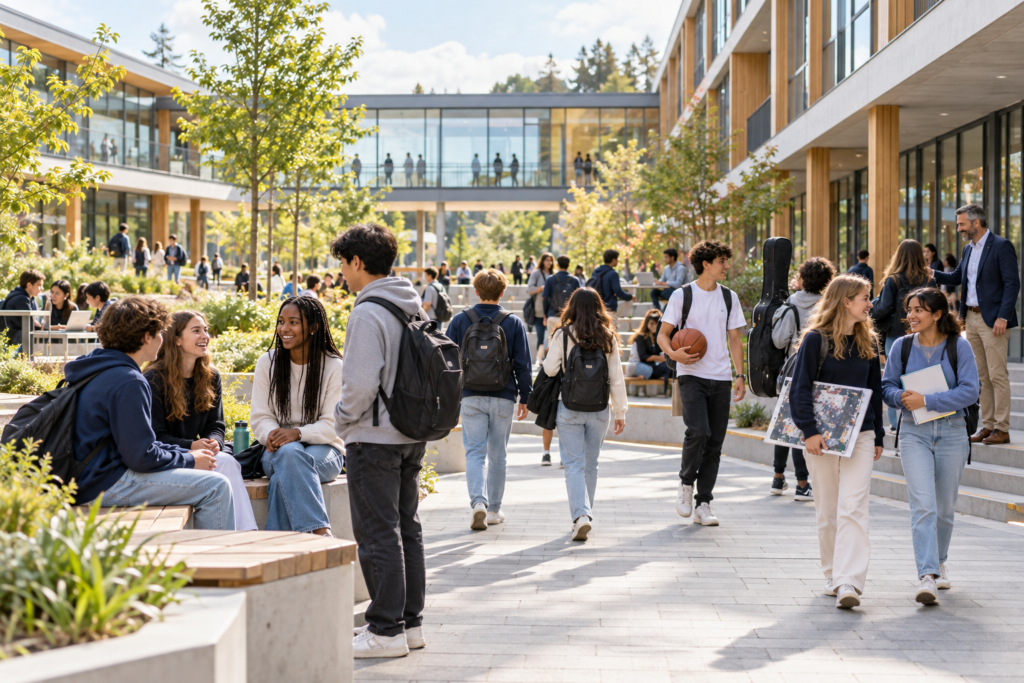
If you’ve started looking at schools in French-speaking Switzerland, you’ve probably already noticed just how many options there are. It’s difficult to narrow them down. One way to approach it is by comparing small and large schools in Geneva and Lausanne. This can help you to understand how enrolment size shapes classroom life, curriculum choice and the feel of the wider school community. School size can influence class sizes, the attention your child receives, the friendships they form, the subjects available and the fees your family pays.
In this guide, we’ll compare smaller and larger schools so you can weigh up the trade-offs. There’s no single “better” choice. It comes down to what your child needs and what matters most to your family. If you’re also considering boarding, our guide to Switzerland’s top boarding schools provides further information about residential education.
Comparison Table: Large vs Small Schools at a Glance
Before we get into individual schools, here’s a quick snapshot of how the two categories typically differ.
| Factor | Large Schools (500+ students) | Small Schools (under 500 students) |
| Class sizes | Approximately 20-24 students | Approximately 9-18 students |
| Individual attention | Available, but structured through year heads and pastoral teams | Teachers may get to know pupils more quickly and deeply |
| Subject range | Often broader at secondary level | May depend on cohort demand |
| Extracurriculars | Extensive: 50-80+ clubs and activities possible | Fewer clubs, but often more accessible (easier to get a spot on a team) |
| Community feel | More cosmopolitan, wider social circle | Close-knit, cross-year friendships common |
| Parent involvement | May be organised through year-group representatives or parent councils | Communication with teachers and school leaders may be more direct |
| Language support | May have larger specialist teams | May provide closer everyday monitoring |
| University guidance | Larger, specialised counselling teams | Smaller teams, but often very hands-on |
| Annual fees | Approximately CHF 20,000-45,000+ | Approximately CHF 20,000-40,000, occasionally similar to large schools |
| Best suited to | Children and families seeking variety and a bigger social pool | Children and families seeking familiarity and a close-knit setting |
The table provides a useful starting point, but these differences aren’t universal. The figures are indicative only. Actual class sizes, activity choices, support services and fees vary by school, campus, year group and programme, so you should confirm current information directly with each school.
Why School Size Matters: What to Consider
School size quietly shapes the day-to-day experience your child will have, often in ways that aren’t obvious until you’re inside the building. Here are the areas where it tends to matter most:
- Class sizes and student-teacher ratios. Smaller schools generally offer more one-to-one attention, simply because there are fewer pupils per teacher. The advantages of small schools can include closer day-to-day contact, greater familiarity across year groups and more direct communication with families.
- Range of subjects and extracurriculars. Larger schools can usually offer more subject combinations at IB or A Level stage, plus a wider spread of clubs and sports.
- Community and social dynamics. In a smaller school, there’s often a true “everyone knows everyone” feeling. In a bigger school, your child has a wider peer group in which to form friendships.
- Specialist support. Learning support, English as an Additional Language (EAL), and counselling services tend to scale with school size, though how personalised that support feels can vary either way.
- Administrative responsiveness. Smaller schools often mean shorter lines of communication between parents and the head of school. Larger schools tend to have more layered systems, with year heads and pastoral teams as the first point of contact.
- University guidance. Bigger schools often have larger, more specialised counselling teams with wide networks. Smaller schools may offer a more personal, one-to-one guidance experience instead.
None of these factors point clearly to “small is best” or “big is best” on their own. Rank these priorities according to your child’s needs, since the right answer looks different for a confident 16-year-old than for a 6-year-old who’s just moved countries.
Large International Schools in Geneva: The Major Players
Geneva has the largest concentration of international schools in French-speaking Switzerland, and a good number of them are sizeable institutions with long histories.
Ecolint
Founded in 1924, the International School of Geneva (Ecolint) is the oldest international school in the world and one of the biggest in the region. It runs three campuses: La Grande Boissière in central Geneva, La Châtaigneraie in Founex, and Campus des Nations in the international district. Programme options vary between Ecolint’s three campuses and include IB programmes, IGCSEs, A levels, and the Swiss Maturité. That breadth of curriculum and scale make it a different proposition from most schools on this list.
Collège du Léman
Based in Versoix, Collège du Léman offers five diploma pathways, including IB, American, IGCSE, French and Swiss options, alongside day and boarding places. It’s known for its sports programme, including football and tennis academies, and its lakeside campus. This breadth of choice may appeal to families who aren’t yet certain which curriculum their child should follow, offering flexibility to transition as your family’s situation evolves over time.
Institut International de Lancy (IIL)
IIL offers English and French secondary pathways. The English section prepares students for IGCSEs and the IB Diploma, while the French section leads to the French Brevet and French Baccalaureate. It has a strong reputation for consistently high IB results and places a strong emphasis on multilingualism from the early years onward. Families seeking strong English and French language provision alongside a choice of secondary pathways may find IIL appealing.
Large International Schools in Lausanne: What’s Available
Lausanne’s international school scene is smaller than Geneva’s overall, but it still has a handful of schools with substantial student numbers.
International School of Lausanne (ISL)
ISL currently welcomes around 850 students from more than 60 nationalities and is the only school in the region offering the full IB continuum. Despite its size, ISL has built a reputation for a warm, values-based community, a useful reminder that large doesn’t automatically mean impersonal. Its recent Diploma results have been above the global average.
Collège Champittet
Founded in 1903, Collège Champittet’s Pully campus serves students through secondary school and offers boarding for those aged 11 to 18. Its bilingual approach and range of Swiss, French and international qualifications provide families with several possible academic pathways.
ENSR International School
With around 600 students, ENSR sits on the smaller side of the large-school category while still offering the resources of a sizeable international school. Its multilingual education leads to either the Swiss Maturité or the IB Diploma, with the IB available in English, French or a bilingual format. The school may appeal to families seeking a bilingual approach rooted in the Swiss education system rather than a primarily English-medium programme.
Small International Schools: Personalised Learning in Geneva
“Small” in this context generally means under 500 students, though some of the schools below are considerably smaller than that.
École Mosaic
Located in Geneva’s Champel neighbourhood, École Mosaic has traditionally taught children aged 3 to 12 and expanded into middle-school education in August 2026. Every class is co-taught by a native French speaker and a native English speaker, and the school represents more than 40 nationalities within a community of a few hundred pupils. It may appeal to families seeking an immersive bilingual education rather than an English-first programme with French added separately.
British School of Geneva (BSG)
Founded in 2005, BSG provides an English curriculum from the early years through IGCSEs and A levels within a close-knit international community representing more than 70 nationalities. Small classes and close staff-pupil relationships are central to how the school describes its approach.
Geneva English School (GES)
Founded in 1961, GES is one of the region’s longer-established English-curriculum schools, with campuses in Genthod and Versoix. It follows the British curriculum through to GCSEs and A levels, bringing together students from more than 60 nationalities. In 2025, 70% of A level grades were awarded at A* or A, while 66% of GCSE grades were at grade 7 or above. Beyond the classroom, students can choose from more than 80 extracurricular activities.
Small International Schools in Lausanne: Boutique Options
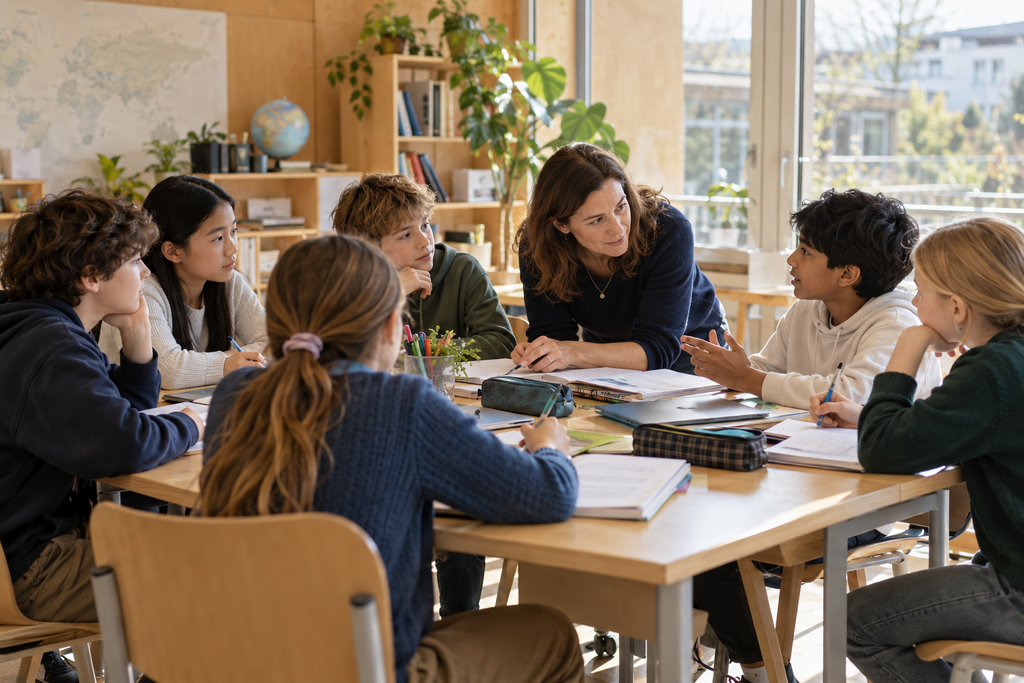
Several smaller international schools in the wider Lausanne region place personalised learning and close community relationships at the centre of their approach.
La Côte International School (LCIS)
LCIS offers an international English-language curriculum, followed by IGCSEs for students aged 14 to 16 and the IB Diploma for those aged 16 to 18. As part of Nord Anglia Education, students can participate in learning opportunities connected to the group’s collaborations with MIT and The Juilliard School. Its rural Aubonne setting and reported student-to-teacher ratio of around 8:1 reflect the school’s emphasis on personalised education. You can read more in our full profile of LCIS Aubonne.
St. George’s International School (Montreux)
A little further afield in Montreux, St. George’s offers IGCSEs followed by a choice of the IB Diploma, General Diploma or A levels, with weekly and full boarding available from age 10. It has a strong sporting and artistic programme and a distinctly British feel, appealing particularly to families who want that specific educational tradition alongside IB flexibility.
The Lausanne Difference: A More Intimate Setting
School size is only part of the story. The city itself shapes the experience too, and Geneva and Lausanne are distinctly different places to raise a family.
Lausanne is noticeably smaller and more relaxed than Geneva, with a lively student atmosphere thanks to institutions like EPFL and a pace of life that feels a bit slower. Geneva has a broader selection of international schools, partly because of its concentration of international organisations.
The Lausanne region has fewer choices of international schools, but families can still consider schools in Pully, Le Mont-sur-Lausanne, Aubonne and Montreux. Fees vary considerably by age, curriculum and services, so direct school-by-school comparison is more reliable than a city-wide average.
Geneva, by contrast, has a more cosmopolitan energy, driven by the concentration of international organisations such as the UN, WHO and ICRC. That brings a bigger, more diverse pool of families and schools, but also more competition for places at the established ones.
Neither city is objectively better for schooling. Families connected to the UN often gravitate towards Geneva since their professional community is there. Families around Lausanne’s university and research institutions, or those wanting a calmer daily rhythm, often find Vaud fits better.
Frequently Asked Questions
What is the difference between small and large international schools in Geneva?
Broadly, small schools in Geneva (under 500 students, and sometimes far fewer) tend to offer smaller classes, closer staff-pupil relationships and a tighter community. Large schools like Ecolint or Collège du Léman offer a wider curriculum choice, bigger extracurricular programmes, and a larger, more diverse student body.
Are smaller schools better for children with learning needs?
Not automatically. Smaller schools can be quicker to notice when a child is struggling, but larger schools often have more developed specialist support teams simply because of scale. Ask any school directly what support looks like in practice.
Which are the best small international schools in Geneva?
École Mosaic, British School of Geneva and Geneva English School are three well-regarded smaller options, each with a different focus, from bilingual PER-English at Mosaic to the full English National Curriculum pathway at BSG and GES.
Which are the best large international schools in Lausanne?
ISL and Collège Champittet are the two largest options, both offering IB pathways, with Champittet also providing French Baccalaureate and Swiss Maturité routes.
Are there small bilingual schools in Geneva?
Yes. École Mosaic is a good example, with every class co-taught in French and English by native speakers of each language, for children aged 3 to 12.
How do fees compare between small and large schools?
There isn’t a consistent pattern. Fees at both generally sit between CHF 20,000 and 45,000 a year, and a small school isn’t automatically cheaper. Boarding adds substantially to the cost either way.
Do smaller schools offer fewer subject choices for IB or A Levels?
Often, yes, simply because fewer students means fewer viable class groups for niche subjects. Most smaller schools still cover the core subjects well, so ask any shortlisted school for its actual subject list.
How can parents tell which school size is right for their child?
Start with your child’s personality rather than the school’s reputation. A confident, sociable child may appreciate the variety and wider peer group of a larger school. A child who values familiarity and close day-to-day relationships may feel more comfortable in a smaller setting. A visit will usually tell you more than any prospectus.