International School of Lausanne (ISL) vs Collège Champittet: Which School Is Right for Your Child?
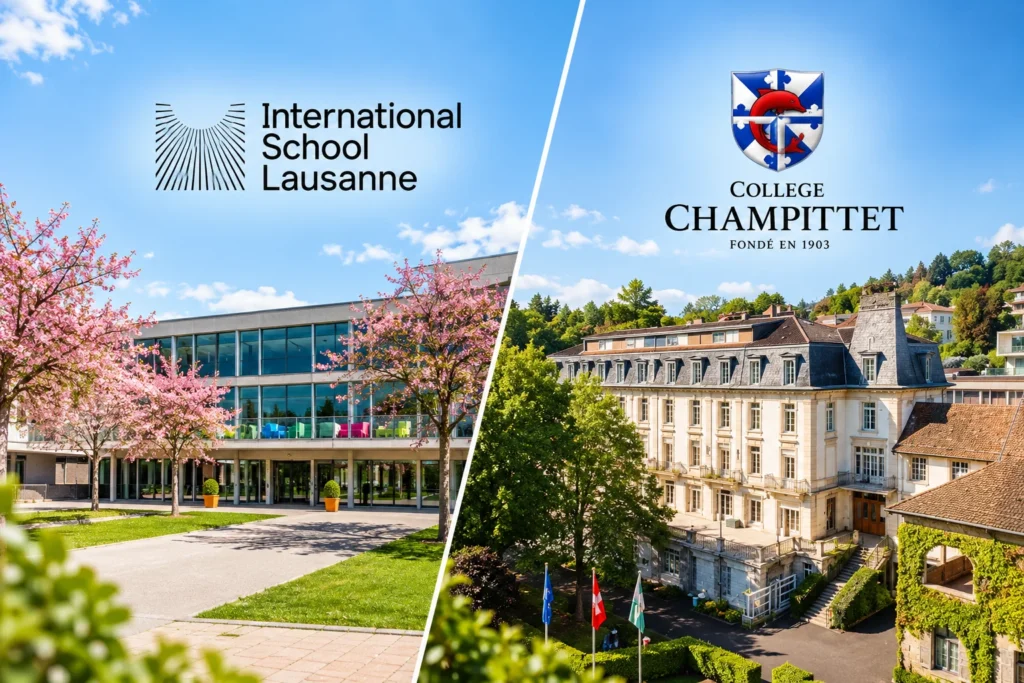
The International School of Lausanne and Collège Champittet are two well-established schools in the Lausanne area educating students from ages 3 to 18. Both welcome local and international learners, but offer distinct educational experiences. ISL is a non-profit day school following the full International Baccalaureate continuum, while Collège Champittet combines day and boarding education with several diploma pathways.
This guide explores their curricula, language models, governance, locations and 2026–2027 fees to help you as a parent decide which school may better suit your child.
Table of Contents
- International School of Lausanne vs Collège Champittet at a Glance
- Key Differences Between ISL and Collège Champittet
- Which School May Be Better for Your Child?
- What Should Parents Compare Before Deciding?
- Frequently Asked Questions
International School of Lausanne vs Collège Champittet at a Glance
The table below offers a quick overview of the main differences between the International School of Lausanne and Collège Champittet.
| Factor | International School of Lausanne | Collège Champittet |
| Location | Le Mont sur Lausanne, north of the city centre | Pully, beside Lake Geneva |
| Ages | 3 to 18 | 3 to 18, with boarding from age 10 |
| School structure | Independent nonprofit school governed by a board | Part of Nord Anglia Education |
| Curriculum | IB Primary Years Programme, Middle Years Programme and Diploma Programme | IB Diploma, Swiss Maturité and French Baccalaureate |
| Main languages | English, with bilingual English and French options in parts of primary and secondary school | French and English, with additional languages taught |
| Day or boarding | Day school only | Day school and five or seven day boarding |
| 2026 to 2027 fees | Tuition from CHF 14,900 to CHF 39,380, depending on age and schedule | Day fees from CHF 12,750 to CHF 38,260; boarding from CHF 91,800 to CHF 112,000 |
| May appeal to | Families seeking full English-medium IB continuity | Families seeking flexibility of academic pathways, bilingual education or boarding |
These differences highlight two distinct school experiences, which families can explore in greater detail throughout this comparison.
Key Differences Between ISL and Collège Champittet
ISL and Collège Champittet offer distinct approaches to education, with important contrasts in their curricula, languages, school structure and student experience.
Curriculum
The International School of Lausanne follows the full IB continuum, guiding students through the Primary Years Programme, Middle Years Programme and Diploma Programme. According to the school’s official overview, ISL is the only school in the Lausanne area authorised to teach all three programmes.
This continuity can help internationally mobile learners remain within a familiar framework. ISL also lists Diploma Programme options and an ISL High School Diploma.
The Collège Champittet curriculum offers more choice during secondary education. Students in Grades 9 and 10 follow either a bilingual French and English route or an English pre-IB route. They can later work towards one of three qualifications:
- The International Baccalaureate Diploma Programme, IB Core taught in English with bilingual Diploma as an option
- The French Baccalaureate, taught in French
- The Swiss Maturité, taught through a bilingual French and English model
These pathways support different language profiles and university plans. Champittet’s secondary curriculum page explains each one.
English and French
English is ISL’s principal language of instruction, but describing the school as English only is no longer accurate. Its bilingual programme for Years 3 to 6 alternates English and French throughout the week, with two teachers planning and delivering the PYP together.
In secondary school, students can study selected science and humanities courses in either language through Year 9. Entry to the primary programme includes a language assessment. ISL’s bilingual programme page explains the pathway.
Champittet integrates French and English from preschool, while primary pupils also study German. In secondary school, the balance between French and English partly depends on the chosen diploma, with German, Italian or Spanish available alongside additional language support.
So, although Champittet has a broader bilingual model, ISL’s primary bilingual programme sets up students to continue studying in both French and English as they continue into high school. Parents should therefore compare the teaching languages used in their child’s year group and their preferred diploma pathway.
Day School vs Boarding
ISL operates exclusively as a day school, so pupils return home after classes. This works well for families living within a manageable distance of Le Mont sur Lausanne.
Collège Champittet welcomes boarders from age 10, with weekly five day and full seven day options. Fees cover tuition, accommodation, meals, mandatory activities, selected trips, books and supervised study. Pocket money, optional trips, private lessons and specialist medical appointments cost extra.
School Structure and Governance
ISL is an independent nonprofit school governed by a board that represents the community, protects its mission and oversees its strategic direction. Champittet follows a different model as part of Nord Anglia Education, an international school group that gives pupils access to wider programmes and collaborations.
Alongside governance, parents can review each school’s leadership, accreditation, policies and communication.
Location and Campus Environment
ISL is located in Le Mont sur Lausanne, north of the city, with dedicated learning, arts and sports facilities. Transport, cafeteria and extended care services are also available.
Champittet has a lakeside campus in Pully, east of Lausanne, where teaching and sports facilities sit alongside boarding accommodation. As travel times vary across the region, families should check the commute during regular school hours.
Tuition Fees
International School of Lausanne fees for 2026 to 2027 vary by year group and, in Reception 3, the number of sessions attended. Tuition starts at CHF 14,900 for four half days per week. A full schedule in Reception 3 or Reception 4 costs CHF 28,490, while annual tuition ranges from CHF 29,300 in Years 1 to 6 to CHF 39,380 in Years 12 and 13.
Pupils entering Years 1 to 13 also pay a one-time acceptance fee, starting at CHF 5,000 for the first child. Transport, meals and optional services cost extra. Full details are available on the official ISL fees page.
Collège Champittet’s 2026 to 2027 day fees include tuition and mandatory activities. Annual costs range from CHF 12,750 for half day preschool to CHF 38,260 in Grade 14, while full day preschool costs CHF 20,850. New pupils also pay a one-time admission fee, starting at CHF 2,500 for the first child, with lower fees for siblings.
Weekly boarding for five days costs CHF 91,800 annually, while full boarding for seven days costs CHF 112,000. A refundable deposit of CHF 10,000 also applies. Examinations, transport, meals for day pupils and language support may cost extra. Full details are available on Champittet’s official fees page.
Which School May Be Better for Your Child?
Each school has different strengths, so the better match will depend on your child’s language needs, preferred curriculum and family circumstances.
International School of Lausanne may be the stronger choice if your family prioritises:
- Full IB continuity from primary school through to the Diploma Programme
- An international environment where English remains the principal teaching language
- Access to bilingual options within an IB school
- An independent nonprofit governance model
- Day education and a pathway that can support future international moves
Collège Champittet may be more appropriate for families that place particular importance on:
- A choice between the IB Diploma, Swiss Maturité and French Baccalaureate
- French and English integration across several stages of education
- Five or seven day boarding
- A qualification connected to Swiss or French university plans
- Greater flexibility when selecting a secondary diploma
The final decision should depend mainly on the preferred curriculum, language needs, boarding requirements and the student’s future academic plans. Visiting both schools can also help you compare the campus atmosphere, facilities and daily experience.
What Should Parents Compare Before Deciding?
Before choosing the International School of Lausanne or Collège Champittet, compare the practical details that will shape the student’s everyday school experience:
- Preferred diploma and the need for full IB continuity
- Current English and French proficiency and goals
- Day or boarding requirements
- Campus location and daily travel time
- Tuition, compulsory charges and optional costs
- Learning and language support
- Class environment and teaching approach
- Extracurricular activities
- University plans: Switzerland, France or further afield
- Availability in the relevant year group
Confirm these details with each admissions team, as programmes and availability may change. For a broader comparison, read ISP’s guide to the best international schools in Lausanne.
Frequently Asked Questions
Is the International School of Lausanne better than Collège Champittet?
Neither school is objectively better. ISL centres its education on the full IB continuum, while Champittet combines three different diploma routes, broader bilingual integration and boarding.
What is the main difference between ISL and Collège Champittet?
ISL is a non-profit IB day school. Champittet belongs to Nord Anglia Education and provides day and boarding education with IB, Swiss and French diploma pathways.
Which school offers more curriculum options?
Champittet has a wider choice of final qualifications, including the IB Diploma, Swiss Maturité and French Baccalaureate. ISL’s main distinction is its complete PYP, MYP and DP continuum.
Do both ISL and Collège Champittet offer the IB?
Yes. ISL follows the PYP, MYP and DP, while Champittet’s IB pathway is limited to the Diploma Programme.
Which school is better for bilingual French and English education?
Champittet integrates French and English across more stages and pathways. At ISL, bilingual learning is available in Years 3 to 6, with selected secondary subjects taught in French through Year 9.
Does the International School of Lausanne offer boarding?
No. ISL operates exclusively as a day school and doesn’t have boarding facilities.
Does Collège Champittet offer boarding?
Yes. Champittet welcomes students from age 10 for five-day or seven-day boarding.
Which school is cheaper, ISL or Collège Champittet?
The cheaper option depends on the student’s age and attendance type. Champittet has a lower starting fee for half day preschool, while comparable full time day fees vary by year group. Its boarding fees are considerably higher than day tuition at either school.
How much does the International School of Lausanne cost?
ISL tuition for 2026 to 2027 ranges from CHF 14,900 for four half days in Reception 3 to CHF 39,380 for Years 12 and 13. Acceptance fees, additional academic charges and optional costs may apply.
How much does Collège Champittet cost?
Champittet’s 2026 to 2027 day fees range from CHF 12,750 to CHF 38,260, including mandatory activities. Boarding costs CHF 91,800 for five days or CHF 112,000 for seven days, with some expenses charged separately.
Articles
Explore our collection of articles on international schools and education in Switzerland. From school comparisons and academic programs to admissions advice and tuition fees, find practical tips and expert insights to help you choose the right school for your child.